Top-Rated Stud Finders: Digital Scanners vs. Magnetic Locators
Selecting the right stud finder depends on your specific project requirements, whether you are hanging heavy shelves or identifying hidden hazards behind drywall. While traditional electronic sensors rely on internal calibrations to detect density changes, modern smartphone-compatible attachments offer visual mapping capabilities that can identify wires and pipes alongside standard studs. Magnetic locators provide a reliable, battery-free alternative by pinpointing the metal fasteners securing drywall to the framing. Understanding the functional differences between these technologies is essential for homeowners and professionals alike. From the precise imaging of the Walabot DIY 2 to the simplicity of magnetic tools, this guide outlines the primary features of leading stud detection solutions currently available to help you choose the most suitable equipment.
When working with drywall, accuracy is paramount to avoid damaging electrical lines or plumbing. Digital sensors like the Zircon StudSensor Pro SL offer a dedicated handheld experience for identifying wood and metal framing. Conversely, magnetic options such as the CH Hanson and StudPoP series utilize rare earth magnets to locate nails and screws, effectively indicating where studs are positioned. If you require advanced diagnostic capabilities, smartphone-integrated scanners provide a digital interface for scanning behind surfaces. Each tool category offers distinct advantages regarding ease of use, power requirements, and detection depth. Evaluating these specifications against your home improvement goals ensures you select a dependable tool that balances technical functionality with user-friendly operation.

1. Walabot DIY 2 – Visual Stud Finder & Wall Scanner for Drywall. Detects Wood & Metal Studs, Plastic & Metal Pipes, Live & Non-Live Wires | Detects wood, metal, pipes and live or non-live wires behind drywall
The Walabot DIY 2 functions as a visual stud finder and wall scanner that pairs with your smartphone to provide a clear view of what lies behind drywall. Unlike traditional sensors, this device is designed to detect wood studs, metal studs, plastic pipes, and metal pipes, while also identifying the presence of both live and non-live electrical wires. Its integration with a mobile device allows users to see visual feedback of the wall's interior, which may assist in avoiding hidden utility hazards during home projects. This unit is specifically engineered for drywall applications, offering a modern alternative to standard beep-based sensors by utilizing smartphone processing power to deliver detailed scanning data directly to the screen.
Best for: Users needing visual confirmation of pipes and wires
Check on AmazonHighlights
- Pairs with smartphones for visual scanning
- Detects both wood and metal framing
- Identifies live and non-live electrical wires
- Locates plastic and metal piping
Keep in mind
- Requires a smartphone for full operation
- May have a steeper learning curve than simple sensors
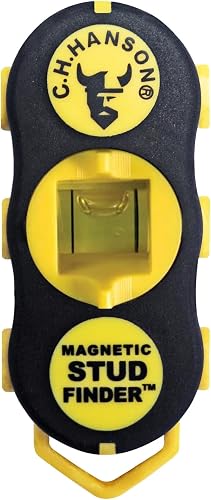
2. CH Hanson Magnetic Stud Finder | Battery-Free Stud Locator with Rare Earth Magnets | Finds Nails & Screws Behind Drywall | Built-In Level for TV Mounting, Shelves & Home Projects
The CH Hanson Magnetic Stud Finder is a battery-free tool that relies on powerful rare earth magnets to locate the metal fasteners hidden behind drywall. By identifying the screws or nails that anchor drywall to the studs, it provides a reliable method for finding the center of wood or metal framing. The device includes a built-in level, which is particularly useful when mounting televisions, installing shelving, or completing other home decor projects that require precise alignment. Because it operates without batteries or complex electronics, it is a straightforward solution for DIY enthusiasts who prefer a simple, maintenance-free tool that is always ready for immediate use without the need for calibration.
Best for: DIY projects requiring both stud detection and leveling
Check on AmazonHighlights
- Uses rare earth magnets for detection
- Battery-free, mechanical operation
- Integrated level for mounting tasks
- Locates metal fasteners in drywall
Keep in mind
- Cannot detect non-metal hazards like pipes
- Relies on fasteners being present in the stud

3. Original StudPoP Moving Magnet Stud Finder, for Any Construction, 1" Magnet
The Original StudPoP is a moving magnet stud finder designed for a wide range of construction tasks. It features a 1-inch magnet intended to attract the metal fasteners commonly used in residential construction. By moving the device across the wall, the magnet reacts when it passes over a screw or nail, providing a simple physical indication that a stud is located underneath. This tool is built for those who value simplicity and portability in their toolkit. It does not require power sources, making it a reliable option for quick checks. Its straightforward design is intended to minimize the guesswork often associated with electronic sensors, offering a tactile response that is easy to understand during installation work.
Best for: Quick, manual identification of stud fasteners
Check on AmazonHighlights
- Simple moving magnet mechanism
- No batteries or calibration required
- Compact and highly portable
- Uses a 1-inch magnet for detection
Keep in mind
- May not detect studs if fasteners are missing or deep
- Limited to finding metal objects only

4. Zircon 58052 StudSensor Pro SL Wood and Metal Stud Sensor
The Zircon StudSensor Pro SL is a dedicated electronic stud finder engineered to locate both wood and metal studs behind drywall surfaces. As a handheld sensor, it provides a traditional user experience, utilizing internal circuitry to detect density changes within the wall to pinpoint stud edges. This model is a long-standing option for those who prefer a standalone tool that does not rely on external hardware or smartphone connectivity. Its design is focused on providing consistent results for standard stud finding applications, such as securing wall mounts or hanging heavy items. The sensor is built to be intuitive, offering clear indicators to help the user identify the location of framing members behind common wall materials.
Best for: Traditional users preferring a standalone digital sensor
Check on AmazonHighlights
- Detects both wood and metal studs
- Standalone handheld electronic device
- Designed for reliable drywall scanning
- No external app or power required
Keep in mind
- Requires batteries for operation
- Lacks the visual mapping found in app-based scanners

5. Grip StudPoP Moving Magnet Stud Finder, 3/4" Magnet
The Grip StudPoP is a magnetic stud finder featuring a 3/4-inch magnet, designed to assist users in locating the metal screws or nails that secure drywall to studs. Similar to other magnetic locators in this category, it functions by attracting to the metal fasteners typically found in wall framing. This version offers a compact design for easy handling during various construction or home improvement projects. By providing a clear physical signal when a fastener is detected, it simplifies the process of finding framing members without the need for electronic calibration or batteries. It serves as a practical, low-maintenance tool for users who need a quick and effective way to locate studs for mounting shelves, pictures, or other wall-anchored items.
Best for: Lightweight, portable stud detection for home repairs
Check on AmazonHighlights
- Uses a 3/4-inch magnet
- Battery-free and maintenance-free
- Simple mechanical detection method
- Highly portable for various projects
Keep in mind
- Detection depth is limited by magnet strength
- Cannot identify electrical wires or plumbing
How to choose
Digital Connectivity
While standard stud finders rely on mechanical or magnetic indicators, the Walabot DIY 2 stands out as the only option in this list designed specifically as a wall scanner attachment for smartphones. It utilizes advanced imaging technology to visualize wood studs, metal studs, plastic pipes, metal pipes, and live or non-live electrical wires behind drywall. By connecting to your phone, it provides a visual interface that simplifies complex wall scanning. This digital approach is distinct from traditional handheld sensors like the Zircon StudSensor Pro SL, which operates as a standalone unit without mobile app integration or screen-based visual feedback.
Magnetic Detection
Magnetic tools like the CH Hanson Magnetic Stud Finder and the StudPoP series function without batteries by using rare earth magnets to locate the metal fasteners—nails or screws—attached to studs. These tools are inherently simple and reliable, as they do not require calibration or power sources. The StudPoP moving magnet design provides a clear visual signal when it detects metal. Because these devices rely on finding the metal hardware inside the wall rather than scanning the material density itself, they are highly effective for locating stud positions in drywall construction where screws are standard.
Sensor Technology
Stud sensors like the Zircon StudSensor Pro SL utilize internal electronic sensors to detect density changes behind the wall surface. These sensors are specifically calibrated to identify the edges of wood and metal studs. Unlike magnetic finders that track fasteners, these electronic sensors are designed to map the actual stud frame. Users should determine if their project requires the precision of a dedicated electronic sensor or the simplicity of a magnetic locator. Each technology serves a different purpose depending on whether the primary goal is locating structural framing members or identifying the specific location of fasteners.
Integrated Features
Beyond basic detection, some tools offer additional utility to assist with installation projects. The CH Hanson Magnetic Stud Finder, for example, includes a built-in level, which is particularly useful for mounting shelves, televisions, or decorative items where horizontal alignment is essential. When choosing a tool, consider whether a secondary feature like a level adds necessary convenience to your workflow. While the Walabot DIY 2 provides high-tech scanning capabilities, it lacks the physical leveling tool found in the CH Hanson model, highlighting the trade-off between advanced scanning technology and integrated mechanical assistance for home projects.
Power Requirements
Consider the power source when selecting a stud finder. Electronic models such as the Walabot DIY 2 and the Zircon StudSensor Pro SL require power, either from the connected smartphone or internal batteries, to operate their sensors. Conversely, magnetic finders like the CH Hanson and StudPoP options are entirely battery-free. This makes magnetic tools highly portable and ready for immediate use without the risk of dead batteries. However, electronic scanners often provide deeper information, such as the detection of live wires, which magnetic tools are generally unable to identify through standard operation.
Frequently asked questions
Can I use my iPhone to find studs in my walls?
Yes, the Walabot DIY 2 is specifically designed to function as a visual stud finder and wall scanner that connects to your smartphone. By using this device, you can view the contents behind your drywall directly on your phone screen. Other products listed, such as the CH Hanson or Zircon StudSensor, are standalone tools that do not require or offer smartphone connectivity to operate.
Do magnetic stud finders require batteries to work?
No, magnetic stud finders such as the CH Hanson and the StudPoP series are completely battery-free. These tools use rare earth magnets to locate the metal screws and nails driven into the studs behind your drywall. Because they rely on simple physics rather than electronic sensors, they are always ready to use and do not require power sources, calibration, or replacement batteries to detect the presence of metal fasteners.
What is the difference between an electronic sensor and a magnetic finder?
Electronic sensors, like the Zircon StudSensor Pro SL, detect changes in material density to identify stud locations. Magnetic finders, such as the StudPoP or CH Hanson, locate the specific metal screws or nails used to attach drywall to the studs. While electronic sensors map the stud framing itself, magnetic finders identify the fastener locations, which indirectly points to the stud's position behind the wall surface.
Which tool is best for detecting electrical wires?
The Walabot DIY 2 is the most capable tool in this selection for identifying electrical hazards. It is explicitly designed to detect both live and non-live wires behind drywall. Traditional magnetic finders and standard density-based electronic sensors are generally limited to finding structural studs or metal fasteners and are typically not designed to detect the presence of electrical wiring inside the wall cavity.
Are there stud finders that include a built-in level?
Yes, the CH Hanson Magnetic Stud Finder includes a built-in level. This feature is designed to assist with home projects such as mounting televisions, installing shelves, or hanging decor where maintaining a perfectly horizontal line is necessary. While other tools in this list, like the Walabot or Zircon sensors, offer advanced scanning technology, they do not include a physical leveling bubble as part of their design.
Bottom line
For users specifically seeking an iPhone-compatible solution, the Walabot DIY 2 is the superior choice. It offers unique visual scanning capabilities that transform a smartphone into a comprehensive wall-imaging system. By identifying wood, metal, pipes, and live wires, it provides significantly more data than the other tools listed. While the Zircon StudSensor Pro SL is an excellent, highly-rated electronic alternative for standalone stud detection, it lacks the visual interface and deep-scanning utility provided by the Walabot. If your priority is advanced, screen-based diagnostics for complex wall scanning, the Walabot DIY 2 is the clear winner, though users should ensure their project requirements align with the specific imaging capabilities of this digital attachment.
Deciding between these tools depends on your specific project needs. If you are performing simple tasks like hanging shelves or mounting a TV, the CH Hanson Magnetic Stud Finder is an ideal, reliable, and battery-free choice that includes a convenient level. For those who prefer a dedicated electronic sensor, the Zircon StudSensor Pro SL remains a highly-rated, industry-standard choice for identifying stud edges. If you need to avoid drilling into pipes or electrical wires, the Walabot DIY 2 is the most advanced option. Choose magnetic finders for simplicity and affordability, or electronic scanners when you require precise structural framing location or safety diagnostics behind your drywall.
More from Hand Tools
Top-Rated Stud Finders: From Pink Precision Tools to Heavy-Duty Scanners
Compare top-rated stud finders including pink electronic detectors and professional-grade scanners from brands like Zircon and Craftsman for your next project.
Read comparison →Top-Rated Stud Finders: High-Tech Wall Scanners and Magnetic Locators Compared
Compare leading wall scanners and magnetic stud finders to find the right tool for your project. We analyze features for detecting studs, pipes, and live wires.
Read comparison →Top-Rated Stud Finders: Magnetic and Electronic Detection Tools Compared
Explore our guide to the best stud finders, comparing magnetic designs like StudBuddy and CH Hanson with electronic options from Zircon, Craftsman, and Prexiso.
Read comparison →