Top-Rated Stud Locators and Wall Scanners: A Guide to Choosing the Right Tool
Choosing the right stud locator is essential for securing heavy items to drywall, framing, or joists without risking damage to hidden electrical lines or plumbing. Whether you are a professional contractor or a weekend DIY enthusiast, the variety of detection technology available can be overwhelming. Some tools rely on electronic sensors to identify wood, metal, and live AC wires, while others utilize powerful magnets to pinpoint fasteners within the wall structure. Understanding the specific capabilities of your chosen scanner, such as center-finding precision or integrated laser leveling, ensures that your mounting projects are safe, accurate, and efficient. We have compiled a breakdown of five popular options to help you determine which features best suit your specific wall-scanning requirements.
When evaluating these tools, consider the specific environment of your project. Electronic scanners like the Povlen or FNIRSI models offer versatile multi-mode detection for various materials, making them suitable for complex wall layouts. Conversely, if you prefer simplicity and reliability without batteries, magnetic options like the Kreg or CH Hanson tools provide a straightforward approach to locating studs. Finally, combination tools that include a laser level, such as the Prexiso, add extra utility for hanging frames or aligning fixtures. By reviewing the core strengths and limitations of each device, you can select a reliable companion for your next home installation or renovation project.

1. Povlen Stud Finder Wall Scanner Detector with Wood Metal AC Wire Detection | 5 in 1 Beam Finder with LCD Display, Edge and Center Detection for Wood, Metal, Live AC Wire, Drywall, Framing, Pipe & Joists
This 5-in-1 wall scanner is designed to identify wood, metal, and live AC wiring behind drywall. It features an integrated LCD display that provides visual feedback for both edge and center detection, which is helpful for framing, pipe, or joist identification. By offering multiple sensing modes in one unit, it aims to simplify the process of locating structural components before drilling. Users should note that electronic sensors may require calibration or a steady hand to maintain consistent readings across different wall textures. The inclusion of live wire detection is a significant safety feature for residential projects, though users must rely on the tool's interface to interpret the findings accurately.
Best for: DIY users needing multi-material detection.
Check on AmazonHighlights
- Identifies wood, metal, and live AC wires
- Includes edge and center detection
- Features a clear LCD display
- Suitable for joists and framing
Keep in mind
- Requires consistent movement for accuracy
- Sensor performance may vary based on drywall thickness

2. Kreg KMM1000LZ - Kreg Magnetic Stud Finder with Laser-Mark - Stud Finder & Wall Scanner - Magnetic Stud Finder Tool - with Precise Stud Magnet
The Kreg KMM1000LZ combines a magnetic stud finder with a laser-mark feature, offering a dual-purpose solution for wall scanning. By utilizing a precise magnet, it detects the fasteners holding drywall to studs, effectively locating the structural framing. The integrated laser-mark adds a layer of convenience, allowing for easier alignment when hanging objects or planning installations. Because it relies on magnetic technology rather than batteries, it is a straightforward tool that avoids the potential complications of electronic sensor calibration. It is a compact addition to any tool bag, specifically designed for those who prefer a mechanical and visual approach to identifying stud locations.
Best for: Users preferring precision laser alignment.
Check on AmazonHighlights
- Magnetic stud detection
- Integrated laser-mark feature
- Compact, battery-free design
- Designed for precise stud location
Keep in mind
- Limited to magnetic detection of fasteners
- Cannot detect non-metallic pipes or wires

3. SNUNGPHIR CH Hanson 03040 Magnetic Stud Finder, 1 Pack
The CH Hanson 03040 is a dedicated magnetic stud finder that focuses on simplicity and ease of use. It works by identifying the metal screws or nails used to attach drywall to the wooden studs underneath. This tool is often favored for its reliability, as it does not require calibration or electrical power, making it ready for use immediately upon removing it from the package. Its small size allows for easy handling, and it is a common choice for those who need a quick way to find framing without the complexity of digital interfaces. While it does not offer the advanced features of a multi-scanner, its focused design provides a consistent method for finding studs.
Best for: Quick and simple fastener detection.
Check on AmazonHighlights
- Reliable magnetic detection
- No batteries required
- Compact and portable design
- Easy to handle for quick checks
Keep in mind
- Lacks electronic wire or pipe detection
- Dependent on the presence of metal fasteners
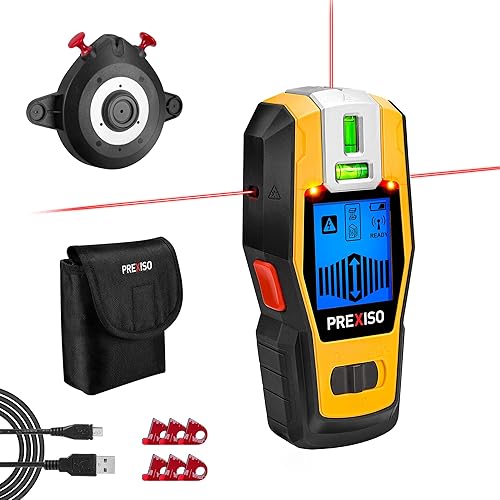
4. PREXISO 2-in-1 Stud Finder with Laser Level, Rechargeable Cross Line Laser | Multi Surface Lazer Leveler Wall Stud Scanners Tool for Hanging Frame & Picture, Wood Ac Wire Metal Stud Joist Pipe Detection
This 2-in-1 tool integrates a stud finder with a rechargeable cross-line laser level. It is designed for multi-surface use, capable of detecting wood, metal studs, joists, pipes, and live AC wires while simultaneously providing a level line for hanging frames or pictures. The rechargeable nature of the device reduces the need for constant battery replacements, and the combination of scanning and leveling features saves time during home improvement tasks. It is well-suited for users who need to mark locations and ensure they are perfectly horizontal or vertical in one go. As with any multi-function tool, users should ensure the device is properly calibrated before beginning sensitive wall work.
Best for: Projects requiring both detection and leveling.
Check on AmazonHighlights
- Includes rechargeable cross-line laser
- Detects wood, metal, pipe, and AC wires
- Multi-surface scanning capability
- Useful for hanging frames and alignment
Keep in mind
- Laser functionality may require periodic calibration
- Requires recharging to maintain laser performance

5. FNIRSI WD-01 6 in 1 Rechargeable Stud Finder Wall Scanner, Positioning Hole | for Wood Drywall Metal AC Wires Joist Pipe Stud Center Detecting, Audio Alarm, Digital Deep Scan Detector Inside the Wall
The FNIRSI WD-01 is a 6-in-1 rechargeable wall scanner that offers a comprehensive suite of features for identifying hidden hazards or structural elements. It provides detection for wood, drywall, metal, AC wires, joists, and pipes. A unique feature is the integrated positioning hole, which allows for marking the wall directly once a stud or object is located. The device utilizes an audio alarm to alert the user when a target is found, which can be useful when scanning at eye level or in awkward positions. Its deep scan capability is designed for thicker walls, though users should always exercise caution when interpreting digital readings near hidden electrical sources.
Best for: Comprehensive scanning with marking capabilities.
Check on AmazonHighlights
- 6-in-1 detection functionality
- Rechargeable power source
- Integrated positioning hole for marking
- Audio alarm for target alerts
Keep in mind
- May have a learning curve for various scan modes
- Audio alerts may be sensitive to interference
How to choose
Detection Technology
Stud locators generally utilize either electronic sensors or magnetic systems. Electronic models, such as the Povlen 5-in-1, the FNIRSI WD-01, and the PREXISO 2-in-1, rely on sensors to identify wood, metal, and live AC wiring behind drywall. Conversely, magnetic tools like the Kreg KMM1000LZ and the CH Hanson 03040 detect the metal fasteners holding drywall to framing members. Electronic units are typically more versatile for multi-material detection, while magnetic finders are often praised for their simplicity and lack of power requirements. Choose based on whether you need to track electrical lines or simply locate the structural studs via their mounting hardware.
Multi-Functionality
Modern stud finders often integrate additional tools to streamline wall-mounting projects. The PREXISO 2-in-1 combines a stud scanner with a rechargeable cross-line laser level, which is useful for aligning frames or shelving precisely. The FNIRSI WD-01 features a 6-in-1 design that includes a positioning hole for marking, while the Kreg KMM1000LZ integrates a laser-mark feature to assist with accuracy. If your workflow involves more than just finding studs, these multifunctional devices can reduce the number of individual tools required for a task. Consider if a single unit with a laser level or marking guide provides enough utility to simplify your specific wall-mounting workflow.
Power Source
The power requirements for stud detectors vary between rechargeable and battery-operated designs. The FNIRSI WD-01 and PREXISO 2-in-1 are rechargeable, which may eliminate the need for frequent battery replacements. Other electronic units typically rely on standard batteries to power their LCD displays and internal sensors. Magnetic stud finders, such as the CH Hanson 03040 and the Kreg KMM1000LZ, do not require any power source at all, making them inherently reliable as they do not depend on internal circuitry or battery life. Evaluate your preference for the convenience of rechargeable units versus the maintenance-free nature of simple magnetic tools for your workshop.
Visual and Audio Alerts
Effective communication between the tool and the user is essential for accurate wall scanning. Many electronic scanners, including the Povlen 5-in-1 and the FNIRSI WD-01, feature LCD displays that offer visual feedback regarding the center and edges of studs. Some models also include audio alarms to alert the user when a target, such as a pipe, joist, or live AC wire, is detected. Magnetic tools use physical tension or visual indicators to signal the presence of metal fasteners. When selecting a device, consider whether you prefer the detailed data provided by digital screens or the straightforward physical indicators found on magnetic alternatives.
Application Scope
The range of materials a device can detect determines its suitability for your home projects. While most scanners are designed for drywall and wood framing, some models offer broader capabilities. The Povlen 5-in-1 and the FNIRSI WD-01 are built to detect wood, metal, AC wires, pipes, and joists, making them suitable for complex renovation tasks. Magnetic finders are specifically designed to locate metal fasteners, which indirectly identifies the position of wood or metal studs. Ensure the tool you select is rated for the specific surfaces you intend to scan, such as plaster, drywall, or specialized wall materials common in residential or commercial construction environments.
Frequently asked questions
What is the primary difference between magnetic and electronic stud finders?
Magnetic stud finders, like the CH Hanson 03040 or Kreg KMM1000LZ, work by locating the metal fasteners or screws used to attach drywall to the studs. They do not require batteries or complex electronics. Electronic stud finders, such as the Povlen 5-in-1 or FNIRSI WD-01, use internal sensors to detect density changes, metal, or live AC electrical wires behind the wall surface. Electronic models are generally more versatile, offering features like LCD displays and audio alerts for various materials.
Can these tools detect electrical wires behind the wall?
Yes, several electronic models are specifically designed to detect live AC wires. The Povlen 5-in-1, the PREXISO 2-in-1, and the FNIRSI WD-01 all list live AC wire detection as a core feature. This is a critical safety function for home improvement projects, helping users avoid drilling into live circuits. Magnetic stud finders do not have the capability to detect electrical wiring, as they are strictly designed to react to magnetic metal objects like screws or nails.
Are there stud finders that include a laser level?
Yes, the PREXISO 2-in-1 Stud Finder specifically includes a rechargeable cross-line laser level, which is helpful for hanging frames and ensuring items are mounted straight. Additionally, the Kreg KMM1000LZ features a laser-mark system to assist with precision. These hybrid tools are designed to combine the detection of studs with the alignment capabilities of a laser, potentially reducing the number of individual tools you need to carry when working on wall-mounting or renovation tasks.
Which stud finder is the most straightforward to use for simple tasks?
For simple, quick tasks, many users prefer magnetic stud finders like the CH Hanson 03040 or the Kreg KMM1000LZ. Since these tools do not require any configuration, calibration, or battery power, they are ready to use immediately. They are highly effective at finding the standard metal screws that secure drywall to studs, which is often all that is necessary for hanging pictures or mirrors. They avoid the potential complexity of digital interfaces or sensor calibration found in electronic units.
How do I choose between a rechargeable and battery-operated electronic scanner?
Choosing between rechargeable and battery-operated scanners depends on your usage frequency. Models like the FNIRSI WD-01 and the PREXISO 2-in-1 feature rechargeable batteries, which can be convenient if you want to avoid the recurring cost and waste of disposable batteries. If you prefer a tool that is always ready without needing a charge, a standard battery-operated model might be more suitable. Consider how often you will be using the tool and whether you have easy access to charging ports in your workspace.
Bottom line
For users requiring comprehensive wall scanning capabilities, the FNIRSI WD-01 6-in-1 and the Povlen 5-in-1 stand out as the strongest electronic options. These devices excel by integrating detection for wood, metal, AC wires, and pipes into a single unit, supported by LCD displays and clear audio alarms. The FNIRSI model adds the benefit of a rechargeable battery and a positioning hole, while the PREXISO 2-in-1 is the top choice for those who need to combine stud detection with a professional-grade cross-line laser level. These tools provide the most diagnostic information, making them ideal for complex projects where identifying hazards like live electrical wires is just as important as locating the structural stud center.
Deciding which stud locator to purchase depends on the technical complexity of your projects. If you are a professional or frequent DIYer performing renovations that involve electrical or plumbing hazards, an electronic scanner with multiple detection modes is the most logical investment. Conversely, if your primary goal is simply hanging wall decor or small shelving, a magnetic finder like the CH Hanson 03040 or the Kreg KMM1000LZ is often superior. These magnetic tools are highly reliable, require no power, and offer a simpler, more intuitive experience for finding the mounting points on wood or metal framing without the potential for sensor miscalibration.
More from Hand Tools

Top-Rated Stud Sensors and Protective Carrying Cases for Wall Scanning
Compare leading wall scanners like the Franklin ProSensor M90 and Zircon StudSensor models. Find the right tool for detecting studs, metal, and live AC wires.
Read comparison →Top-Rated Stud Sensors and Wall Scanners for Precise Detection
Explore top-rated stud sensors and wall scanners. Compare features for wood, metal, and live wire detection to find the best tool for your workshop needs.
Read comparison →
Top-Rated Stud Sensors and Wall Scanners for Precise Detection
Compare top-rated stud sensors for wood, metal, and live AC wire detection. Find the best wall scanner tool for your mounting and installation projects today.
Read comparison →